Trading Meme Coins With a $10 Portfolio
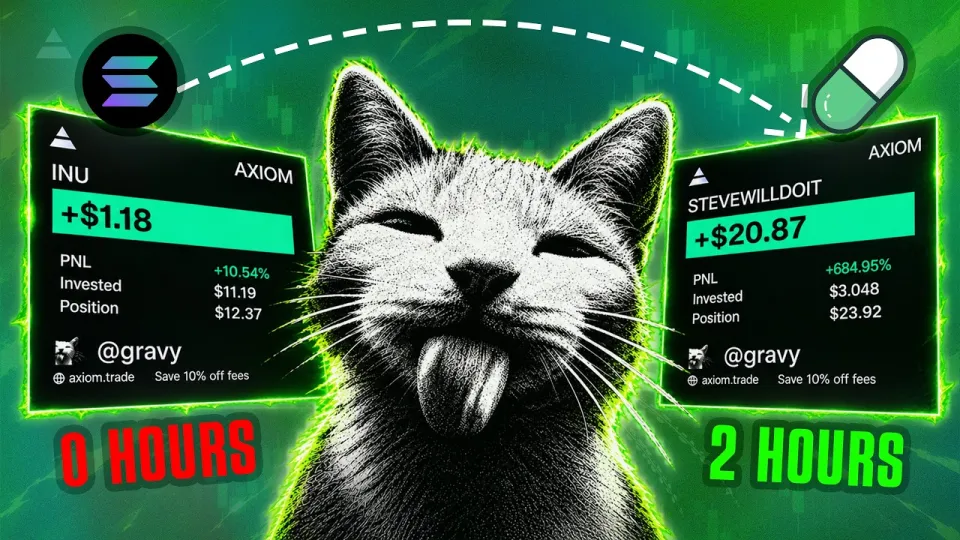
Video: I Tried Trading Memecoins with Just $10
Need articles like this for your video? They help promote it on YouTube and Google — order them in the Telegram bot @sat_sit_bot. It writes articles around your video, embeds the video and publishes them on popular niche websites (no ads). Free trial — 50 articles.
· based on the channel gravy
Meme coin trading with a $10 portfolio is possible on Solana because transaction fees are measured in cents, not dollars — but the edge comes from narrative selection and exit discipline, not from the size of the bankroll. A $10 stack (roughly 0.05 SOL per buy at recent prices) can take five separate positions, and each one lives or dies on whether you understood why the coin was moving. The experiment run by the channel gravy, which bought five meme coins on Axiom without ever exceeding 0.05 SOL per entry, is a useful template for anyone starting small.
What a $10 meme coin portfolio actually looks like
A $10 bankroll on Solana is not a rounding error — it is a stress test of your process, because every cost is proportionally huge. At that size, the round trip on a single trade includes the platform fee, the pool fee, priority tips for landing the transaction, and slippage on both sides. On a 0.05 SOL buy, a 1% platform fee plus a small priority tip can quietly consume several percent of the position before the price even moves. That is why small-portfolio traders must treat fees as a fixed cost of entry and demand a bigger move to break even.
The practical rules that follow from this:
- Cap each buy at a fixed fraction of the stack — in the gravy experiment, 0.05 SOL per trade across five trades.
- Only enter coins with a narrative you can state in one sentence, because you cannot afford to average down into a story you do not understand.
- Set an invalidation level before buying; on a $2 position, a 40% drawdown is $0.80, and hoping is not a strategy.
- Prefer liquid pairs so the exit does not slip against you.
The five trades and the narratives behind them
The five positions in the experiment were STEVEWILLDOIT, NPC, MET (Meteora), PUMPY the Trader and UNTXD, and each was chosen for a specific reason rather than for a chart pattern. STEVEWILLDOIT belongs to the "Steve will do it" meme lineage — a personality-driven coin where attention spikes drive volume. NPC is the reflexive internet meme about non-player characters, a theme that recurs in crypto every cycle because the joke is self-explanatory and travels fast on social feeds. MET is tied to Meteora, the Solana liquidity protocol, which makes it a meta-play on the ecosystem rather than a pure joke. PUMPY the Trader and UNTXD are launchpad-native tickers, the kind that appear on pump.fun-style venues and live or die within hours.
The X Money coin meta that ran during the same period is the clearest illustration of how these narratives form: it moved on the e/acc and Cream associations rather than on any product news. Traders were not pricing a payment rail — they were pricing the attention of a specific online faction. Understanding that distinction is the difference between buying a story and buying a chart.
Why narrative beats technicals at this size
At a $10 portfolio, technical analysis is mostly noise, and narrative is the only signal with enough magnitude to pay for fees. Meme coins on Solana do not have cash flows, so price is a function of attention flow: who is talking about the ticker, how fast the conversation is spreading, and whether the people talking have a track record of moving markets. A coin with a strong, legible story can double in minutes; a coin with a good chart and no story tends to bleed.
The catch, and the one most beginners hit, is timing. By the time a narrative is obvious enough to feel safe, the early buyers are already distributing. That is why the same coin produces two very different experiences: the trader who bought the first mention and the trader who bought the retweet. If you cannot identify which side of that curve you are on, the position is a lottery ticket, not a trade.
Common questions from small-portfolio traders
Most of the friction reported by people trading with tiny balances is not about picking coins — it is about process. A recurring complaint is that a coin with an apparently strong narrative still loses money, because the entry came after the crowd had already priced the story in, or because a 20–40% stop-out happened right before the coin ran higher. Both are symptoms of the same problem: entering on confirmation rather than on thesis, and sizing so that a normal pullback forces an exit.
Another frequent issue is information overload — the feeling that you must read every post, remember every influencer, and track every community to catch narratives early. In practice, most successful small traders follow a narrow set of accounts and a single venue, and accept that they will miss most coins. Missing a runner costs nothing; chasing one costs the whole stack. A third theme is transparency: viewers of the gravy experiment asked for a final profit-and-loss figure, which is a fair request and a reminder to log every entry, exit and fee so the result is measurable rather than remembered.
Risk rules that keep a $10 experiment honest
Risk management at this scale is about survival, not optimization, because the goal of a small-portfolio test is to learn whether your process works before you add capital. Treat the $10 as tuition: assume some trades go to zero, and never add funds mid-experiment to rescue a position. Keep a written log of the thesis for each buy, the planned exit, and the actual result. If a coin's story cannot be explained to someone else in one sentence, skip it. And remember that liquidity on launchpad tokens can vanish in seconds — a position that shows a profit on screen may not be sellable at that price when volume dries up.
Useful links
- Axiom trading terminal (referral, 2x cashback and reduced fees): https://axiom.trade/@gravy
- The Trenches Discord: https://discord.gg/W7TqkExcSd
- Discord with free Axiom imports and trade signals (NFA): https://discord.gg/9W5j3XUgYB
- gravy on X: https://x.com/gravyski
- Leverage trading with a 20% futures fee reduction: https://www.bitbase.com/landing-page/trading-earning-Gra?ref=8CYOGY
Bottom line
A $10 portfolio is enough to learn meme coin trading properly, because it forces you to respect fees, pick narratives deliberately, and exit without ego. The gravy experiment is a good model: five trades, fixed 0.05 SOL sizing, and an honest accounting of one badly fumbled position alongside the winners. The lesson is not that small accounts get rich — it is that the discipline required at $10 is exactly the discipline that matters at $1,000. If you want to replicate the setup, start through the Axiom referral link and keep the first month's size deliberately small.
Key takeaways
- Five real trades on Solana, none larger than 0.05 SOL per buy
- Tickers covered: STEVEWILLDOIT, NPC, MET (Meteora), PUMPY the Trader, UNTXD
- The X Money coin meta ran on e/acc and Cream narrative, not on fundamentals
- Fees and priority tips matter more at $10 than at $1,000 — sizing is the whole game
- One trade was fumbled badly, which is the normal outcome for most small-portfolio attempts
Source: I Tried Trading Memecoins with Just $10 · Markdown version
Questions & answers
Can you really trade meme coins with only $10?
Yes, on Solana, because network fees are fractions of a cent and a $10 stack can be split into several 0.05 SOL positions. The constraint is not access but cost efficiency: platform fees, priority tips and slippage take a larger percentage of a tiny position, so you need a bigger move to profit.
How do you find meme coins with a strong narrative before they run?
Follow a narrow list of accounts that have historically moved attention, and check whether a ticker's story can be explained in one sentence. Narratives built on recognizable memes or ecosystem names spread faster than abstract ones. Accept that you will miss most coins — chasing after the crowd has arrived is the most common way small accounts lose.
Why do small trades lose money even when the coin later goes up?
Usually because the entry came after the narrative was already public, so the first pullback triggers a stop-out before the move continues. Sizing too large relative to the stack makes this worse. Entering on a thesis rather than on confirmation, and setting invalidation levels in advance, reduces this pattern.
What fees should you expect when trading meme coins with a small balance?
Expect a platform fee of roughly 1% per side on many terminals, plus pool fees, priority tips for transaction landing, and slippage on entry and exit. On a 0.05 SOL buy these can add up to several percent of the position, which is why fixed sizing and fewer, better-selected trades beat rapid-fire scalping.